Three integrated calculators work with your equipment library. Select a telescope and camera and every calculation fills in automatically.
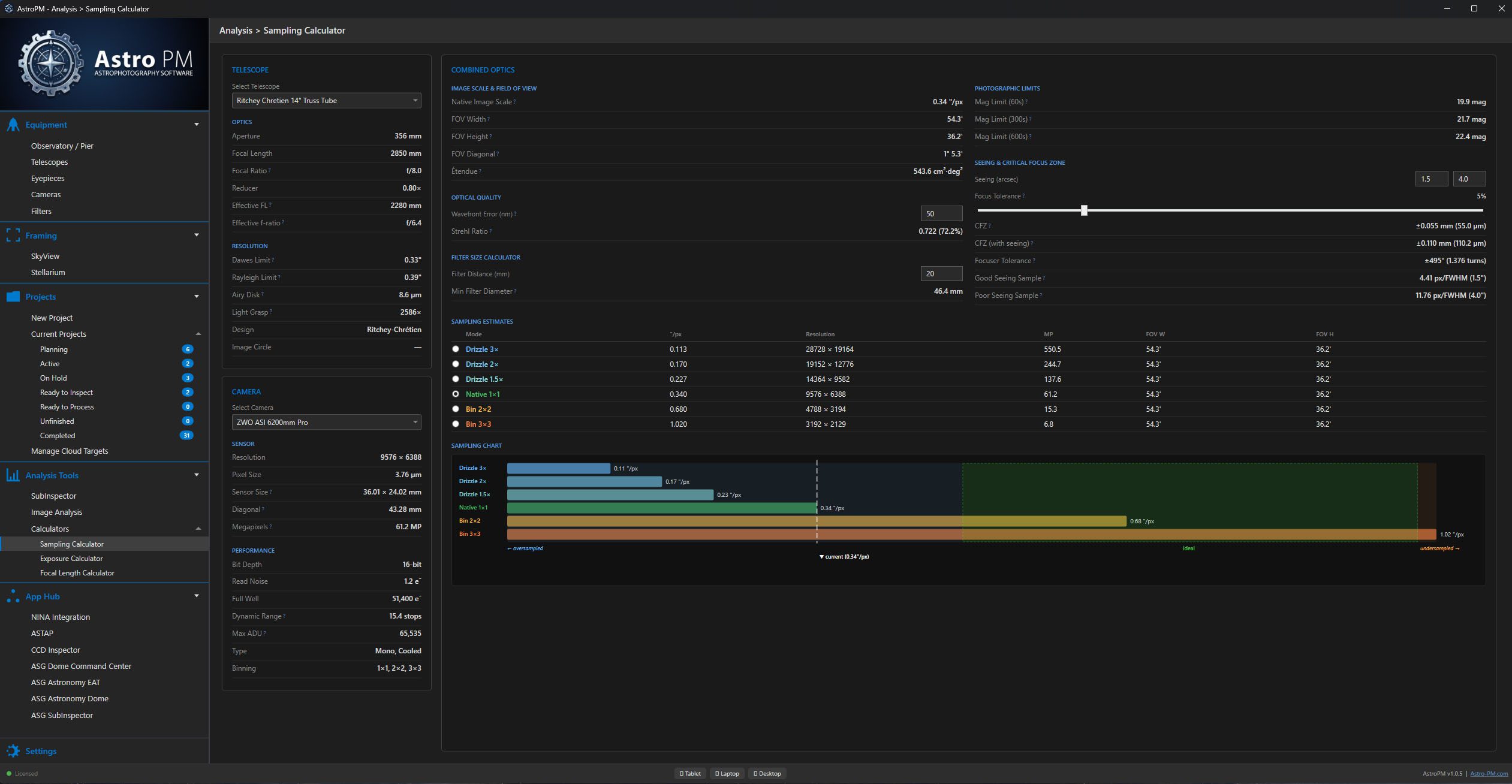
Sampling Calculator
What is your resolution? Plate scale in arcseconds per pixel computed instantly from your equipment. Assess whether you’re oversampled, undersampled, or optimally matched to your seeing conditions.
Includes drizzle and binning simulation modes so you can model resolution changes before committing to a processing strategy.
Plate Scale
Arcseconds per pixel computed instantly from your telescope and camera pairing.
Seeing Match
Over-sampled, under-sampled, or optimally matched to your typical seeing conditions.
Drizzle & Binning
Model resolution changes before you commit — simulate 2×2, 3×3 binning and drizzle modes.
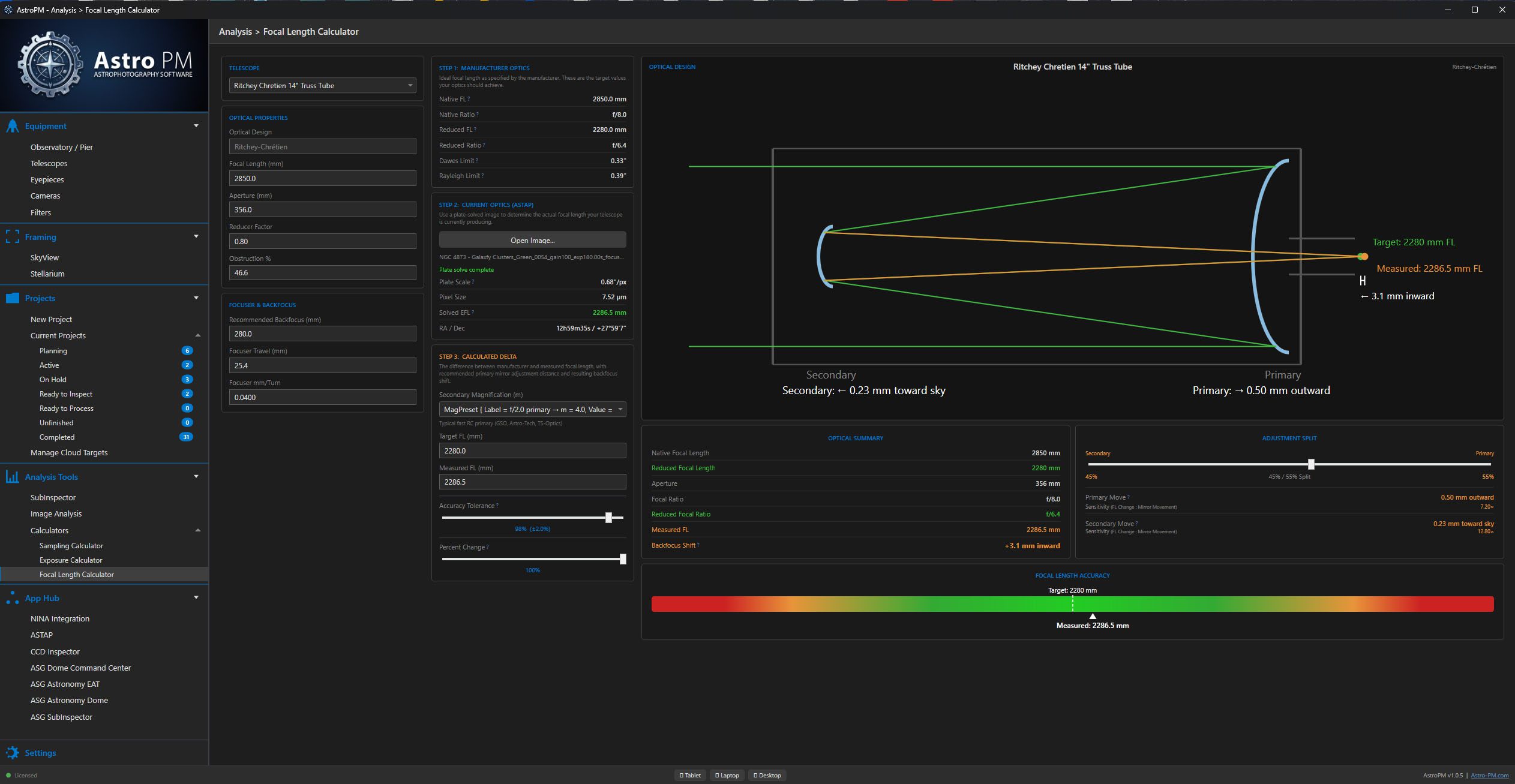
Focal Length Calculator
Model optical systems and compare configurations. Apply focal reducers and see the resulting system specs. Platesolve and calculate your mirror adjustment needs for secondary and primary systems.
System Modeling
Stack telescopes, reducers, and extenders — see the combined focal length and ratio instantly.
Platesolving Precision
Recommended vs platesolved focal length differences along with accuracy compensation.
Adjustability in Mind
Adjust primary or secondary by varying degrees by sliding back and forth. 100% primary to 100% secondary values.
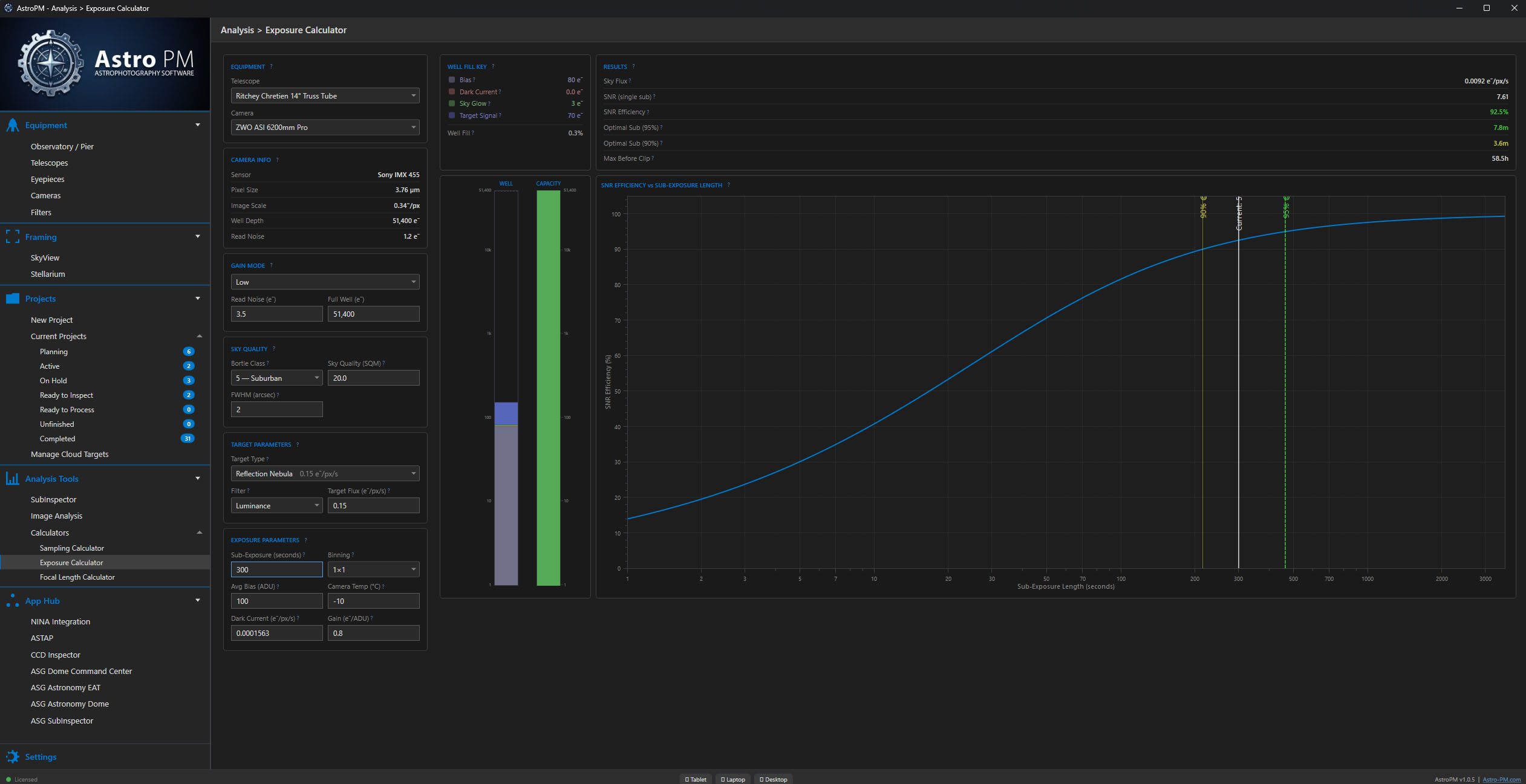
Exposure Calculator
Answer the question every imager asks: how long should my exposures be? Auto-fills focal length, aperture, pixel size, read noise, dark current, QE, and gain profiles from your equipment library.
See single-sub SNR, efficiency percentage, optimal exposure time, and a full well-fill breakdown showing bias, dark current, sky, and signal. An interactive efficiency curve with 200+ data points shows exactly where longer exposures stop helping.
SNR & Efficiency
Per-sub signal-to-noise efficiency checks. Based on your skies, your target, your equipment.
Well-Fill Breakdown
Visualize exactly what's filling your sensor — bias, dark current, sky background, and target signal. Full Well/Low Gain or Low Well/High Gain?
Efficiency Curve
How does your exposure length, sky quality, bortle, target compare to 90%-95% efficiency? Graph it and see!