
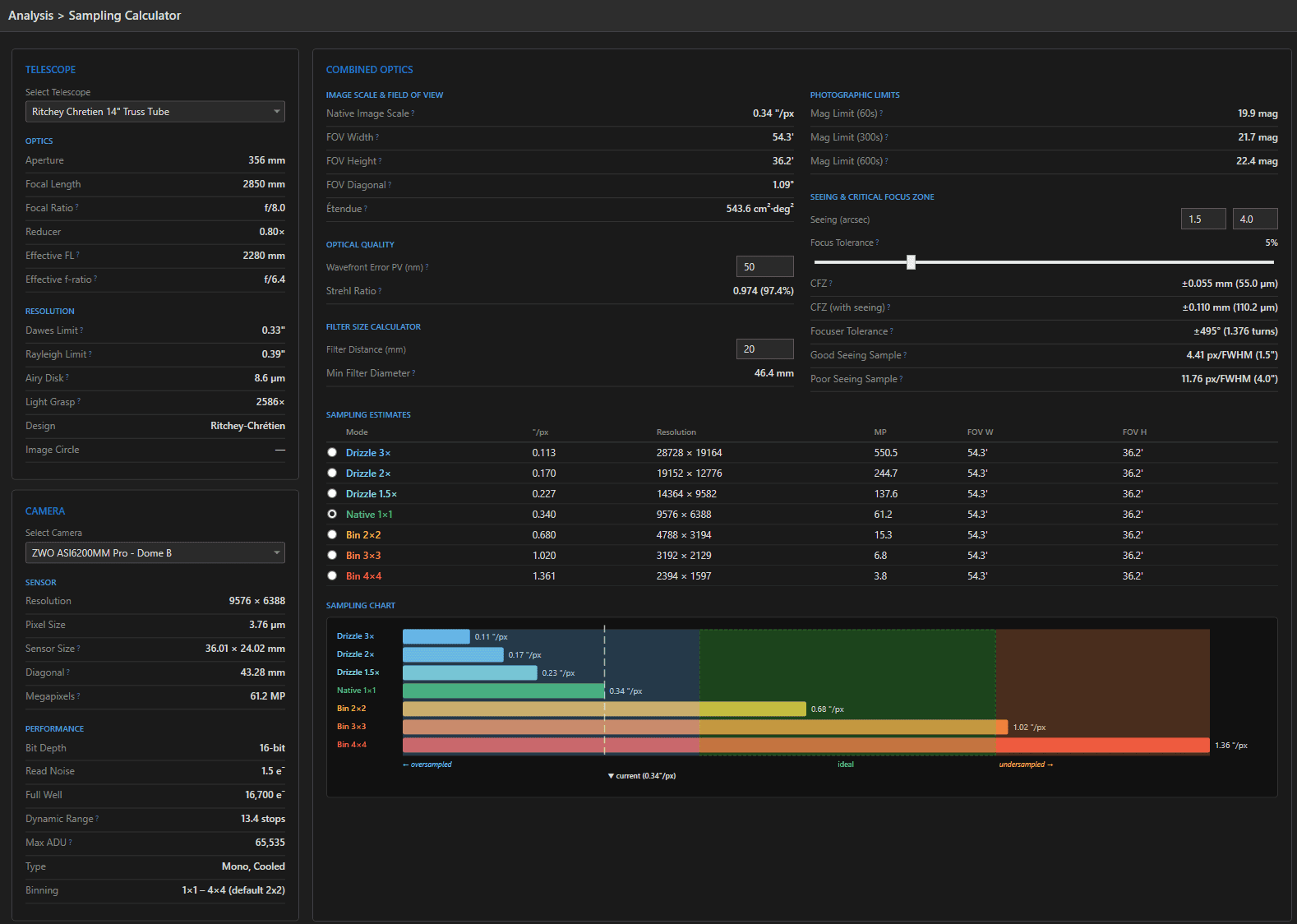
The Sampling Calculator is the spec sheet your equipment combination never came with: pick a telescope and camera and every optical and sensor figure of merit is derived live – no data entry, no formulas to remember.
Telescope Figures #
| Figure | How it is computed | What it tells you |
|---|---|---|
| Focal ratio / effective FL | FL / aperture; FL × reducer | speed and true focal length with your reducer |
| Dawes limit | 116 / aperture (mm) | closest double star you can split (arcsec) |
| Rayleigh limit | 138 / aperture (mm) | formal diffraction limit at 550nm |
| Airy disk | 2.44 × λ × f-ratio | diffraction spot size in microns – compare to your pixel size |
| Light grasp | (aperture / 7)² | light gathering vs. the dark-adapted eye |
Camera Figures #
Sensor dimensions, diagonal, and megapixels from resolution × pixel size, plus the performance numbers that matter for imaging: read noise, full well, dynamic range in stops (log₂ of full well / read noise), and max ADU from bit depth. Binning capabilities are listed as configured in your Equipment library.
The Combined System #
- Image scale – 206.265 × pixel size / focal length, in arcsec/px: the single most consequential number of the pairing.
- Field of view – width, height, and diagonal, in arcminutes and degrees.
- Étendue (AΩ) – collecting area × sky solid angle: the survey-power metric that lets you compare a fast widefield against a big slow SCT on one axis.
Sampling vs. Your Seeing #
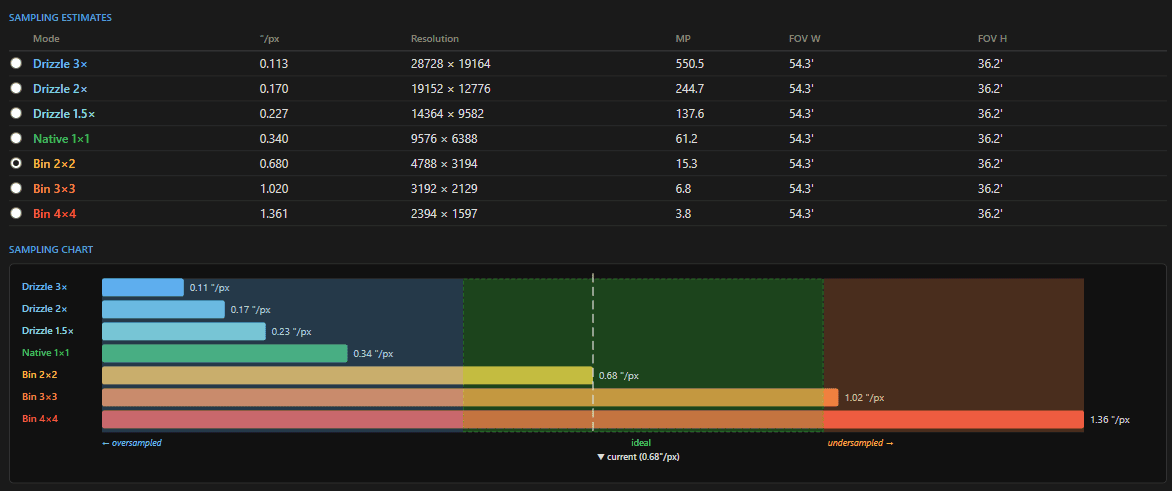
The sampling section divides seeing FWHM by image scale to get pixels per FWHM, evaluated at both your best and worst typical seeing. The target zone is the Nyquist-ish 2-3 px/FWHM: below ~2 you are undersampled (blocky stars, lost resolution), well above 3 you are oversampled (spreading photons thin for no detail gain – though binning can fix that downstream). Because it shows both seeing extremes, you can judge whether a combination works across your real conditions, not just on the best night of the year.
Optical Quality: Strehl From Wavefront Error #
Enter your optics’ wavefront error (P-V, nm – e.g. λ/4 at 550nm is ~137nm) and the calculator applies the Maréchal approximation to estimate Strehl ratio. Above 0.8 is the classic “diffraction-limited” bar. Useful for translating a test report into an intuition for what the glass actually delivers.