Not every night is an imaging night. The Eyepieces section is Astro PM’s nod to visual observing: catalog your eyepieces and barlows once, and the app answers the eternal eyepiece-case question – which one for this target? – with real numbers for every scope you own.
The Fields #
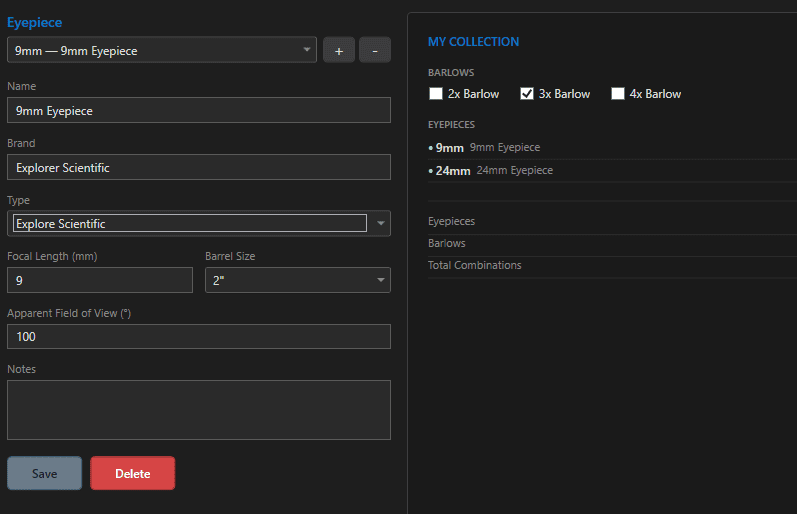
| Field | Notes |
|---|---|
| Name / Brand | e.g. “Nagler 31mm”, Tele Vue |
| Type | Plössl, Super Plössl, Kellner, Orthoscopic, Nagler, Ethos, Delos, XW, Morpheus, Explore Scientific – organizational |
| Focal Length (mm) | the magnification driver: scope FL / eyepiece FL |
| Apparent FOV (°) | 30-82° typical; wider = more immersive |
| Barrel Size | 1.25″, 2″, 3″ |
Barlows live in the same collection with a barlow factor instead of a focal length – the quick checkboxes (2×, 3×, 4×) add or remove them from your inventory in one click.
What the Collection Computes #
For every eyepiece (and every eyepiece × barlow combination) against your telescopes:
| Figure | Formula | Why it matters |
|---|---|---|
| Magnification | scope FL / eyepiece FL (× barlow) | the basic power of the combination |
| True field of view | apparent FOV / magnification | how much sky you actually see – will the Pleiades fit? |
| Exit pupil | aperture / magnification | match to your eye: ~1-7mm useful range |
The Magnification Coverage Chart #
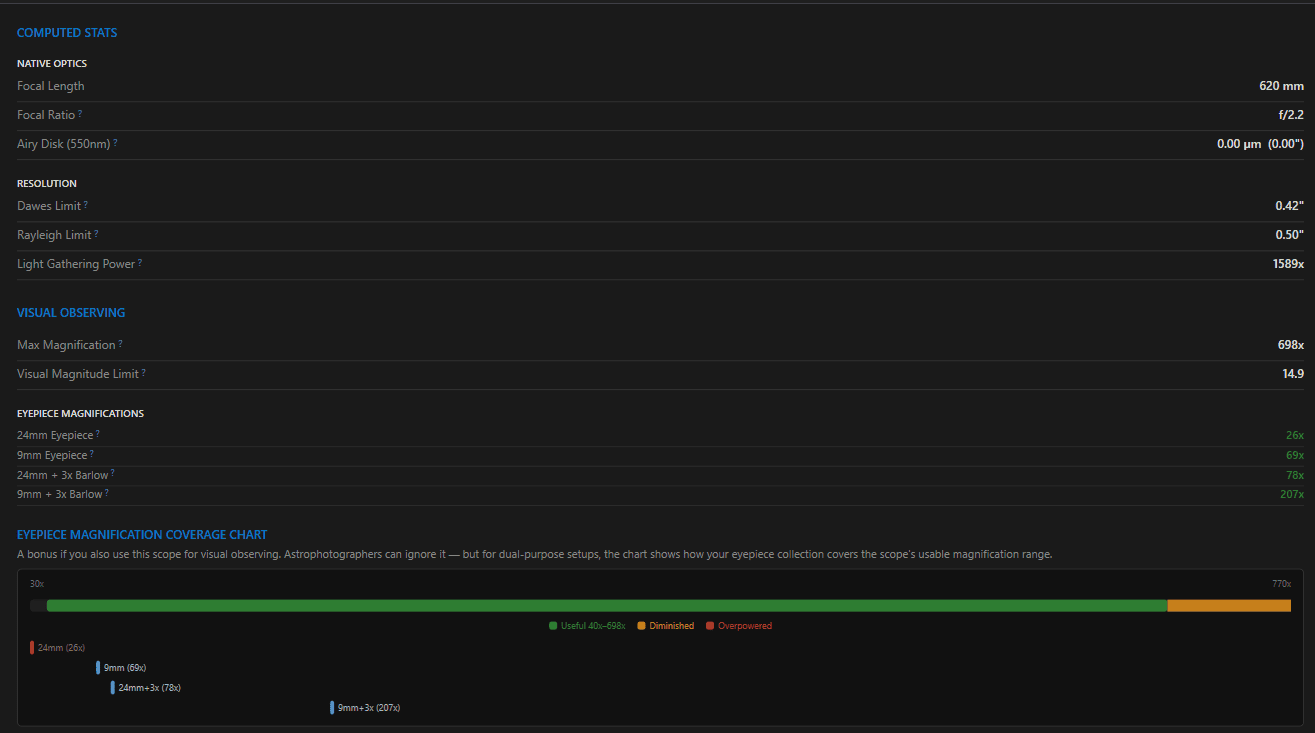
The chart plots every combination you own across the magnification range, with shaded guidance for sensible power per your aperture. Gaps jump out instantly – the classic discovery being a case full of eyepieces that all land between 80× and 120×, and nothing for wide-field sweeping or planetary nights. Consult it before buying the next eyepiece, not after.
Scope of This Section #
Eyepieces are deliberately standalone: they are not part of Imaging Systems, are not consumed by the scheduler or exposure calculators, and do not sync to NINA or the phone – they are a visual-observing planning tool, kept alongside the rest of your gear so the whole observatory lives in one inventory.
If you visit your telescope section, it will give you a spectrum of where your eyepieces land with that optical telescope system visually. The graph is a good way to tell if you have basic coverage across eyepieces and the equipment.